

Assembly lines no longer treat screwdriving as a purely mechanical step. Intelligent electric screwdrivers and nutrunners already deliver precise, controlled tightening with torque and angle feedback. They can also be supported with AI. The next layer is software and data workflows around those tools, so every fastening stays consistent, traceable, and easier to improve.
This article explains what AI in intelligent screwdriving means on the factory floor, where signature-curve models help most, and how that fits with platforms like Qplorer. No hype, and no claims we cannot support from published product facts.
What intelligent screwdriving already means
Intelligent electric screwdrivers and related fastening tools (for example Kolver intelligent screwdriver ranges and DSM electronic nutrunners that Micromeasures supplies) are built for controlled fastening. They set torque and angle behaviour, give real-time feedback to the operator or controller, and support Industry 4.0 data paths.
Published capacity spans a wide band depending on the brand and model family. Kolver intelligent electric screwdriver ranges typically go up to about 70 Nm. DSM tools in the Micromeasures line cover much higher fastening needs, up to about 2,400 Nm. Always match the exact tool to the joint specification.
That hardware layer is the foundation. AI does not replace a calibrated transducer or a well-specified joint. It helps teams use the data those tools produce and steer the process when conditions change.
Torque-angle signature curves: the data AI needs
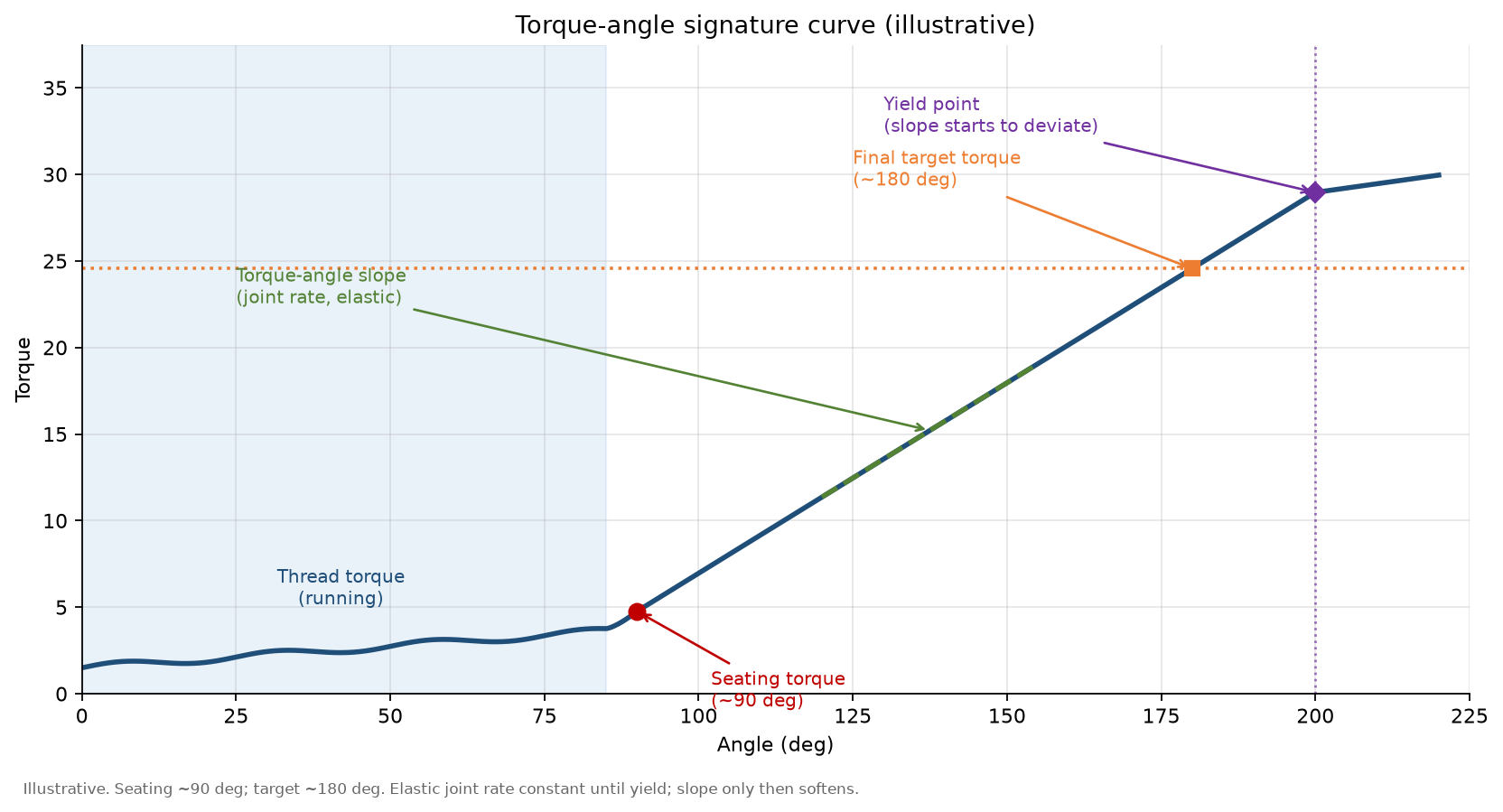
Illustrative signature only. Labels: thread torque (running), seating torque, constant elastic torque-angle slope (joint rate), final target torque, and yield point (where slope starts to deviate). The joint-rate slope does not drop before yield.
Intelligent screwdrivers do more than report a final OK or NOK. During the fastening cycle they can produce a torque-angle signature curve, with process features such as:
- Thread torque (running torque while the fastener advances down the thread)
- Seating torque (the point where the head seats and clamp load begins to build)
- Joint rate (how torque rises with angle after seating, which reflects joint stiffness)
- Overall curve signature shape across the cycle
Those features describe a “normal” fastening for a given joint, tool, and job. When you have enough good cycles, you can characterise what normal looks like.
Where AI adds value on the screwdriving station
Intelligent screwdrivers can be supported with AI in a few concrete ways.
1. Models from normal curves, flags on deviation
AI can build models from normal torque-angle curves for a joint. Major deviations in seating torque, joint rate, or overall curve signature can then be flagged as a wrong or abnormal process. That goes beyond a single final-torque threshold. It helps catch issues such as wrong fastener, cross-thread, soft joint, missing washer, or bit problems earlier in the cycle.
2. Process monitoring beyond a single limit
Every OK/NOK cycle and curve feature is a signal. Pattern recognition (rules, plus learned models where plants allow) can watch trends over time: a drift in seating torque, a change in joint rate, or signature shapes that no longer match the trained normal. The goal is fewer silent quality escapes, while safety-critical limits stay under engineering control.
3. Smarter work instructions and sequencing
AI-assisted systems can help select or adapt the next fastening step based on job ID, part variant, or MES state. Combined with on-screen guidance, that keeps the operator in a locked, auditable sequence instead of relying on memory.
4. Linking tool data to the rest of the plant
Screwdriving data is most useful when it leaves the station. On modern intelligent electric screwdrivers, wireless data transfer is commonly over Wi-Fi or Zigbee. Other radios are less common for this class of tool. MES-connected workflows (REST, OPC-UA, MQTT and similar) then let quality, maintenance, and production share what was tightened, when, and with what curve result.
Intelligent screwdrivers and Qplorer: the practical stack
A useful way to think about the stack:
- Tool layer: intelligent electric screwdrivers and nutrunners (Kolver up to ~70 Nm, DSM up to about 2,400 Nm in the ranges Micromeasures supplies) with torque/angle control, signature curves, and feedback.
- Orchestration layer: software such as [Qplorer](/products/qplorer/), Micromeasures’ intelligent torque tool management system. It connects to torque tool hardware, pushes Hi/Lo limits from the workflow, aims for high capture of readings (published target 98% to 100%, with buffering and keep-alive), and syncs results to MES platforms.
- Guidance layer: on-screen work instructions and station sequencing so the correct job, limits, and records stay locked together.
AI belongs mainly in (2) and in how you analyse the signature-curve data that (1) produces. The tool still has to hit the joint correctly. The software decides which limits, which step, which normal model, and which record belong to that job.
Manufacturing benefits you can plan for (without invented ROI)
Teams adopting this pattern typically look for:
- Earlier detection of wrong process. Curve and seating/joint-rate checks catch problems a final torque number can miss.
- Fewer configuration errors. Limits come from the workflow instead of being typed in by hand every changeover.
- Better audit trails. Each tightening can be tied to job, tool, curve features, and result.
- Cleaner MES quality data. Results available to plant systems via standard protocols where integrated.
Exact savings depend on your product mix, changeover rate, and how much fastening data you already capture. Treat pilots as measurement exercises, not promises.
Implementation tips for Indian automotive and electronics lines
- Start with the joint, not the model. Document nominal torque, angle strategy, seating behaviour, and failure modes before training curve models.
- Calibrate and keep tools in range. Intelligent screwdriving assumes the tool is within its certified behaviour. Pair this with your calibration programme (Micromeasures also operates NABL-traceable torque calibration services).
- Collect enough “good” curves before you treat a model as a gate. Normal must be real plant data, not a lab wish.
- Decide what AI will own. Monitoring and deviation flags first. Keep safety-critical OK/NOK thresholds under clear engineering control.
- Standardise job IDs and workflows so the right limits and the right normal model apply every time.
- Train for the new UI. Operators should trust on-screen steps and lockouts, not fight them.
FAQ
What is AI in intelligent screwdriving?
It is the use of data-driven software around intelligent electric screwdrivers and nutrunners so fastening stays within process intent and results are traceable. A common pattern is learning normal torque-angle signature curves (including thread torque, seating torque, and joint rate), then flagging major deviations as a wrong process. AI complements torque and angle control in the tool. It does not replace that control.
Do I need AI to use intelligent screwdrivers?
No. Intelligent screwdrivers already provide precise controlled tightening and feedback, including rich cycle data. AI becomes valuable when you want models of normal curves, automated deviation flags, automated limit push, high capture of readings, MES sync, and deeper insight across many stations.
How do Kolver and DSM fit the torque range?
In the Micromeasures line, Kolver intelligent electric screwdriver ranges typically cover up to about 70 Nm. DSM fastening tools cover higher industrial joints, up to about 2,400 Nm depending on the model. Confirm the exact catalogue range against your joint.
How does Qplorer fit in?
Qplorer is an intelligent torque tool management system. It can connect to torque tool hardware, push workflow-based Hi/Lo limits, capture readings at high completeness, show live dashboards and work instructions, and integrate with MES over REST, OPC-UA, or MQTT.
How do these tools usually send wireless data?
For intelligent electric screwdrivers, wireless data transfer is commonly Wi-Fi or Zigbee. Other radios are less common in this category. Always check the specific tool’s communication options.
Next steps
If you are planning AI-ready screwdriving on an automotive, electronics, or general engineering line (tool selection across Kolver and DSM ranges, signature-curve process control, or Qplorer workflow design), talk to Micromeasures. Call or email the Chennai or Pune team, or Ask Mira on micromeasures.com for a guided starting point. We will follow up with a human recommendation.